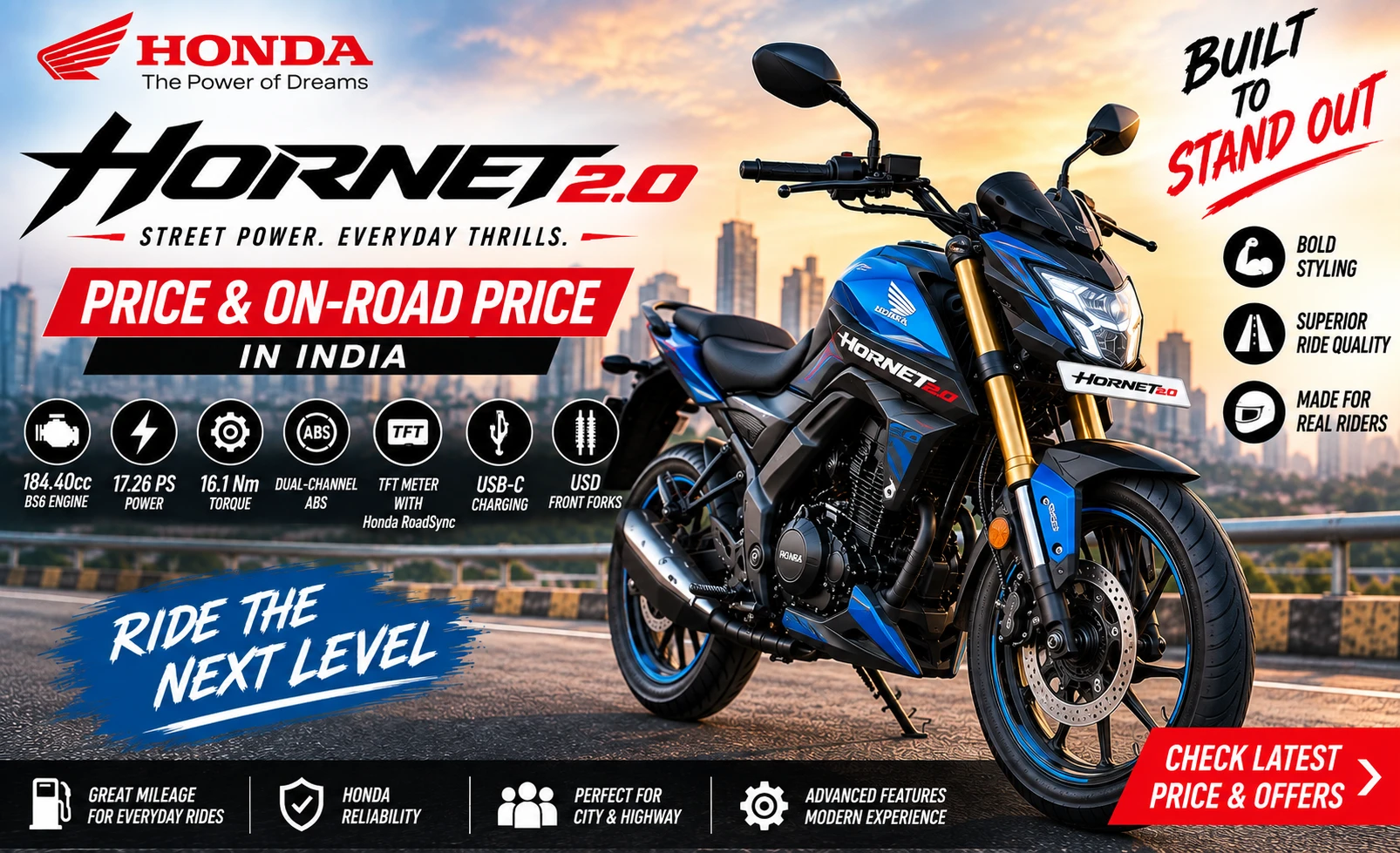

Honda Hornet 2.0 Price & On-Road Price in India
The Honda Hornet 2.0 is a sporty naked motorcycle aimed at riders who want more performance and equipment than a conventional commuter without moving into the price and physical size of larger premium motorcycles. Its appeal comes from a combination of an efficient 184.4cc engine, aggressive styling, low-to-medium weight, upside-down front forks and modern electronics.
The current Hornet 2.0 uses a 184.40cc, single-cylinder, air-cooled engine with fuel injection. Honda’s current technical information lists 12.5 kW of maximum power at 8,500 rpm and 15.7 Nm of torque at 6,000 rpm. It also gets a five-speed gearbox, assist/slipper clutch, dual-channel ABS, Honda Selectable Torque Control, LED lighting, a TFT meter, Honda RoadSync connectivity and USB-C charging.
For many prospective buyers, however, the first question is the Honda Hornet 2.0 on road price. The final amount can be considerably higher than the ex-showroom price because registration, road tax and insurance are added during the purchase process.
As a current September 2026 Kolkata reference, BikeWale lists the Hornet 2.0 at ₹1,49,598 ex-showroom and ₹1,81,655 on-road, including an estimated ₹19,350 RTO charge and ₹12,707 comprehensive insurance. Other online calculators can show different figures, so a written dealer quotation should always be treated as the final buying reference.
This guide covers the Honda Hornet 2.0 price, on-road price, engine, performance, mileage, specifications, features, comfort, suspension, braking, colours, maintenance, ownership costs, alternatives, buying tips and common mistakes.
Honda Hornet 2.0 Price in India
The current Hornet 2.0 is positioned as a premium 180–200cc street motorcycle. Honda’s current India product page lists the motorcycle with a 184.40cc engine and premium equipment such as a TFT meter, RoadSync, USD front forks, USB-C charging and dual-channel ABS.
Current third-party pricing data shows the motorcycle at approximately ₹1.50 lakh ex-showroom in India, with the exact price depending on the city. In Kolkata, BikeWale currently lists ₹1,49,598 ex-showroom.
| Price Information | Honda Hornet 2.0 |
|---|---|
| Current model | Honda Hornet 2.0 |
| Engine | 184.40cc |
| Current Kolkata ex-showroom reference | ₹1,49,598 |
| Current Kolkata on-road reference | ₹1,81,655 |
| Current listed variant | Standard |
| Transmission | 5-speed manual |
Prices can change because manufacturers revise prices, taxes can differ by state and dealers may offer different schemes. Therefore, use online pricing as a starting point rather than as a guaranteed final invoice.
For the latest manufacturer information, visit the official Honda Hornet 2.0 product page.
Honda Hornet 2.0 On-Road Price
The Honda Hornet 2.0 on road price is the amount you need to budget for after the major purchase-related costs are added to the motorcycle’s ex-showroom price.
For Kolkata, the current BikeWale calculation is:
| Cost Component | Kolkata Reference |
|---|---|
| Ex-showroom | ₹1,49,598 |
| RTO | ₹19,350 |
| Comprehensive insurance | ₹12,707 |
| Estimated on-road price | ₹1,81,655 |
This is an indicative online calculation for September 2026. Your final amount may differ because insurance premiums, registration calculations and optional items can change.
What Is Included in the Hornet 2.0 On-Road Price?
- Ex-showroom price: The motorcycle’s base selling price before registration and insurance.
- RTO charges: Registration and applicable road-tax components.
- Insurance: Mandatory motor insurance and any selected additional coverage.
- Other applicable charges: Depending on the purchase arrangement and location.
- Accessories: Optional equipment selected by the buyer can increase the final amount.
When comparing dealer quotations, ask for each item separately. An itemised quotation makes it much easier to see whether a difference is caused by the motorcycle price, insurance, registration or optional accessories.
Why Does the Honda Hornet 2.0 On-Road Price Differ by City?
The ex-showroom price is only one part of the calculation. State-specific registration and taxation rules affect the amount payable when a new motorcycle is registered.
Insurance is another variable. Different insurers may quote different premiums based on the selected coverage and policy terms.
Optional accessories or additional services can further increase the final invoice.
The Government of India’s Parivahan permanent-registration guidance provides official information about the registration process.
Honda Hornet 2.0 Specifications
The Hornet 2.0 has a relatively compact mechanical package for a sporty 184cc motorcycle. Honda’s current BigWing product information lists a 184.40cc engine, 12.5 kW power at 8,500 rpm and 15.7 Nm torque at 6,000 rpm. The engine uses PGM-FI fuel injection and is paired with a five-speed gearbox.
| Specification | Honda Hornet 2.0 |
|---|---|
| Engine Type | Single-cylinder, 4-stroke, SI engine |
| Displacement | 184.40cc |
| Cooling | Air cooled |
| Fuel System | PGM-FI fuel injection |
| Maximum Power | 12.5 kW @ 8,500 rpm |
| Maximum Torque | 15.7 Nm @ 6,000 rpm |
| Transmission | 5-speed manual |
| Clutch | Assist and slipper clutch |
| Front Suspension | Upside-down fork |
| Rear Suspension | Monoshock |
| Front Brake | Disc |
| Rear Brake | Disc |
| ABS | Dual-channel |
| Fuel Tank | 12 litres |
| Seat Height | 790 mm |
| Ground Clearance | 168 mm |
| Kerb Weight | 142 kg |
| Front Tyre | 110/70-17 tubeless |
| Rear Tyre | 140/70-17 tubeless |
The 142 kg kerb weight, 790 mm seat height and 168 mm ground clearance make the Hornet 2.0 relatively approachable within the sporty 180–200cc category. The exact experience will still depend on rider height, inseam, riding position and road conditions.
Honda Hornet 2.0 Engine and Performance
The Hornet 2.0 uses a 184.4cc air-cooled single-cylinder engine. With 12.5 kW of maximum power and 15.7 Nm of torque, it is designed to provide a useful combination of city response and highway capability.
The engine’s peak torque arrives at 6,000 rpm, which gives the motorcycle a useful mid-range character. In normal city riding, that can reduce the need for constant downshifting when moving through traffic or making an overtake.
The five-speed gearbox keeps the motorcycle mechanically straightforward. Honda also gives the Hornet an assist/slipper clutch, which is intended to make clutch operation lighter and help reduce rear-wheel hopping during aggressive downshifts.
The motorcycle is not a full supersport machine. Its strength lies in being a relatively compact streetfighter that can work for weekday commuting while still providing enough performance for enthusiastic weekend riding.
Is Honda Hornet 2.0 Good for City Riding?
For many riders, yes.
- The 142 kg kerb weight helps with parking and low-speed manoeuvring.
- The 790 mm seat height is accessible for many riders.
- The 5-speed gearbox is suitable for urban traffic.
- The assist clutch reduces effort during repeated gear changes.
- The upright streetfighter riding position works well for normal commuting.
- The 12-litre fuel tank is useful for frequent riders.
The motorcycle is more substantial than a commuter such as a 125cc bike, but riders moving from a small motorcycle should be able to adapt after a proper test ride.
Honda Hornet 2.0 Mileage
Mileage is not the primary reason to buy a Hornet 2.0, but its 184.4cc engine can still provide reasonable efficiency when ridden sensibly.
Current Autocar India specifications list approximately 42.3 kmpl, while online owner reports can differ substantially depending on riding conditions. Another current Honda Hornet 2.0 data source lists approximately 42 kmpl as the ARAI figure and around 45 kmpl as an owner average.
Real-world fuel economy can change because of:
- Traffic congestion
- Average speed
- Throttle input
- Rider and passenger weight
- Tyre pressure
- Road surface
- Service condition
- Highway versus city use
How to Calculate Your Real Hornet 2.0 Mileage
- Fill the tank to a consistent level.
- Reset the trip meter.
- Ride normally on your everyday routes.
- Refuel after covering a meaningful distance.
- Record the litres added.
- Divide kilometres travelled by litres consumed.
- Repeat the calculation over several fuel stops.
For example, if you ride 500 km and use 12 litres, your measured mileage is approximately 41.7 kmpl.
This number is more useful for your personal fuel budget than assuming the motorcycle will always return a particular advertised or database mileage.
How to Improve Honda Hornet 2.0 Mileage
Good fuel economy comes from a combination of riding technique and maintenance.
- Keep tyre pressure at the manufacturer’s recommended level.
- Accelerate progressively instead of using unnecessary full-throttle inputs.
- Use the appropriate gear for the speed and traffic conditions.
- Avoid sustained high-rpm riding when it is not needed.
- Keep the drive chain properly lubricated and adjusted.
- Follow the recommended maintenance schedule.
- Avoid unnecessary luggage.
- Reduce repeated hard acceleration followed by heavy braking when road conditions allow.
Fuel economy should never come at the expense of safe riding or appropriate speed.
Honda Hornet 2.0 Features
The current Hornet 2.0 stands out because Honda has equipped a relatively accessible motorcycle with features normally associated with more expensive models.
TFT Meter
Honda’s current Hornet 2.0 page highlights a TFT meter designed to display real-time performance information. It gives the motorcycle a more premium interface than a basic LCD or analogue commuter console.
Honda RoadSync
Honda RoadSync provides connected functions and information through the motorcycle’s display. It is intended to support hands-free operation and information access while riding.
Connectivity can be useful for riders who depend on their smartphone during daily commuting, but riders should always configure connected features while stationary rather than interacting with a phone while moving.
USB-C Charging
The current Hornet 2.0 includes a USB-C charging connection. This is especially useful for riders who use their phone for navigation or who need to keep a device charged during longer trips.
Assist and Slipper Clutch
The assist and slipper clutch reduces clutch effort and is designed to help minimise rear-wheel hopping during aggressive downshifts. Honda specifically lists this technology among the motorcycle’s equipment.
LED Headlamp
The Hornet 2.0 uses LED lighting and a distinctive streetfighter-style headlamp. Besides the visual benefit, LED lighting is now an important part of modern motorcycle equipment.
Honda Selectable Torque Control
Honda Selectable Torque Control, or HSTC, manages rear-wheel spin by adjusting engine power. It gives the motorcycle an additional electronic layer of assistance when grip conditions change.
Like ABS, traction control is not a replacement for responsible riding. Road speed, tyre condition and surface grip remain critical.
Honda Hornet 2.0 Brakes and Safety
Safety equipment is one of the Hornet 2.0’s strongest areas.
The current motorcycle is equipped with dual-channel ABS and disc brakes at both ends. Honda’s official page specifically highlights dual-channel ABS for greater control during braking.
| Safety Equipment | Hornet 2.0 |
|---|---|
| ABS | Dual-channel |
| Front brake | Disc |
| Rear brake | Disc |
| Traction control | Honda Selectable Torque Control |
| Hazard switch | Yes |
| Engine stop switch | Yes |
ABS can help reduce the likelihood of wheel lock during hard braking, while traction control can help manage rear-wheel slip. Neither system can overcome physics, so riders should still maintain appropriate speeds and following distances.
Honda Hornet 2.0 Suspension and Handling
The Hornet 2.0 uses golden upside-down front forks and a rear monoshock. The USD fork is one of the motorcycle’s most visually distinctive components and also supports the streetfighter’s handling-focused character.
Honda’s official product information describes the USD front fork as helping handle bumps, while its comfort section highlights the riding posture for both streets and highways.
Compared with a traditional telescopic fork, an upside-down fork also gives the motorcycle a more premium appearance. However, the presence of USD forks should not be treated as a guarantee of perfect ride quality because damping, spring rate, tyre pressure and road surface all influence how a motorcycle feels.
Honda Hornet 2.0 Design
The Hornet 2.0 has a forward-leaning, muscular streetfighter design.
Honda uses a bulky fuel tank, angular bodywork, a compact tail section, LED headlamp and sporty alloy wheels to give the motorcycle a more aggressive appearance.
The gold-coloured USD front forks add a strong visual contrast to the bodywork and immediately distinguish the Hornet from conventional commuter motorcycles.
Its design should appeal particularly to riders who want a sporty motorcycle without moving to a fully faired sportbike.
Honda Hornet 2.0 Seat Height and Comfort
The current Hornet 2.0 has a 790 mm seat height.
This is an important number for shorter riders because it can affect confidence when stopping or moving the motorcycle around while stationary.
However, seat height alone does not tell you exactly how accessible a motorcycle will feel. Seat width, rider inseam, suspension sag and the shape of the seat also matter.
The best approach is to sit on the motorcycle and check whether you can comfortably support yourself at traffic lights before booking.
Honda Hornet 2.0 Weight and Dimensions
The Hornet 2.0 weighs approximately 142 kg kerb, according to current specifications. Its ground clearance is about 168 mm, while the fuel tank holds approximately 12 litres.
| Dimension | Honda Hornet 2.0 |
|---|---|
| Kerb Weight | 142 kg |
| Seat Height | 790 mm |
| Ground Clearance | 168 mm |
| Fuel Tank | 12 litres |
| Front Tyre | 110/70-17 |
| Rear Tyre | 140/70-17 |
These figures make the Hornet relatively manageable for an urban street bike. Its wide rear tyre also contributes to the motorcycle’s substantial appearance and planted riding character.
Honda Hornet 2.0 Colours
Current listings show four colour options for the Hornet 2.0:
- Athletic Blue Metallic
- Matte Axis Grey Metallic
- Pearl Igneous Black
- Radiant Red Metallic
Colour availability may differ by dealership and stock. Confirm the actual colour available before paying a booking amount.
Honda Hornet 2.0 for Daily Commuting
The Hornet 2.0 is more practical as a daily motorcycle than its aggressive appearance might suggest.
The 790 mm seat height is reasonably approachable, while the 142 kg kerb weight helps keep the bike manageable in traffic. The five-speed gearbox and assist/slipper clutch also suit repeated urban riding.
The TFT meter and RoadSync connectivity add everyday convenience, particularly for riders who use navigation regularly.
The main compromise is that the Hornet is still a performance-oriented 184cc motorcycle. It costs more to run than a 100cc or 125cc commuter and is likely to consume more fuel than those smaller motorcycles when used under the same conditions.
Honda Hornet 2.0 for Highway Riding
The 184.4cc engine gives the Hornet 2.0 enough performance for occasional highway use.
The five-speed gearbox and 15.7 Nm torque provide a useful balance for overtaking and steady open-road travel. The stable chassis, dual-channel ABS and wide tyres also add confidence when road conditions are suitable.
However, the Hornet remains a naked motorcycle, so wind exposure becomes more noticeable as speed increases. Riders who frequently spend several hours on highways should take this into account.
For short weekend trips, the motorcycle is likely to be more naturally suited than for long-distance touring involving many consecutive hours in the saddle.
Honda Hornet 2.0 Maintenance
Honda currently states that the Hornet 2.0 comes with a standard warranty of 3 years or 42,000 km, whichever comes earlier, from the date of purchase.
Honda’s current service information lists the first three free-service intervals as approximately:
| Service | Distance | Time |
|---|---|---|
| 1st Free Service | 750–1,000 km | 15–30 days |
| 2nd Free Service | 5,500–6,000 km | 165–180 days |
| 3rd Free Service | 11,500–12,000 km | 350–365 days |
The earlier of the distance or time condition applies according to Honda’s published schedule. Always check the latest documentation applicable to your motorcycle.
Useful maintenance checks include:
- Engine oil level and replacement interval
- Air filter condition
- Drive-chain adjustment and lubrication
- Brake-pad and disc condition
- Tyre pressure and tread
- Battery condition
- Coolant and electrical-system checks where applicable
- Suspension and steering components
- Clutch operation
- Lighting and electronic systems
For model-specific documentation, use Honda’s official owner’s manual resources.
Honda Hornet 2.0 Insurance Cost
Insurance forms a meaningful part of the on-road purchase cost. Current Kolkata online calculations put comprehensive insurance at approximately ₹12,707 for the Hornet 2.0, but this is an indicative figure rather than a universal premium.
Insurance premiums can change depending on the insurer, coverage, location and policy details.
Third-party liability insurance is mandatory for vehicles operating on public roads in India. The Insurance Regulatory and Development Authority of India advises customers to compare premiums, coverage and deductibles.
Before purchasing, read the IRDAI motor-insurance guidance.
Honda Hornet 2.0 Running Cost
The Hornet 2.0 is not an ultra-low-cost commuter, but its operating expense can remain manageable when ridden sensibly.
Suppose you ride 1,000 km each month and your actual average is 42 kmpl.
1,000 ÷ 42 = approximately 23.81 litres
At a hypothetical petrol price of ₹100 per litre:
23.81 × ₹100 = approximately ₹2,381 per month
This is only a budgeting example. Replace the mileage and fuel price with your actual numbers.
For a realistic annual budget, also include:
- Insurance renewal
- Scheduled servicing
- Engine oil and filters
- Brake pads
- Tyres
- Chain and sprocket wear
- Battery replacement
- Optional accessories
Honda Hornet 2.0 EMI and Finance Considerations
Online finance calculators can make the motorcycle look affordable through a low monthly EMI, but EMI should never be the only number you compare.
Before taking a loan, check:
- Down payment
- Interest rate
- Loan tenure
- Processing fees
- Insurance financing, if applicable
- Total repayment amount
For example, extending a loan term may lower the monthly EMI while increasing the total interest paid over the life of the loan.
Honda’s own online EMI tool notes that interest rates and finance approval depend on the financial institution and that its calculation is illustrative.
Honda Hornet 2.0 vs Honda NX200
The Honda NX200 is one of the closest Honda alternatives to the Hornet because it shares the 184.4cc engine family while offering a different riding concept.
The Hornet 2.0 is a streetfighter with forward-leaning styling and a more aggressive road presence. The NX200 uses an adventure-inspired design and can be more suitable for buyers who want a higher-riding position and a more versatile appearance.
If sporty street riding is the priority, the Hornet is the more obvious choice. If mixed urban and light touring use is more important, the NX200 deserves a test ride.
Honda Hornet 2.0 vs Bajaj Pulsar N160
The Bajaj Pulsar N160 2V price and on-road price guide is useful for buyers comparing the Hornet with a more affordable 160cc naked motorcycle.
The N160 has a 164.82cc engine and focuses heavily on value and everyday usability. The Hornet steps up to a 184.4cc engine and combines its additional performance with Honda’s TFT, RoadSync, USD forks, traction control and dual-channel ABS equipment.
The decision therefore depends on budget. The N160 can make more sense for a buyer who wants a lower purchase cost, while the Hornet appeals to someone willing to spend more on performance and premium equipment.
Honda Hornet 2.0 vs TVS Apache RTR 160 4V
Our TVS Apache RTR 160 4V price and on-road price guide provides another useful comparison.
The Apache RTR 160 4V is strongly oriented toward sporty performance, while the Hornet offers Honda’s combination of refined 184.4cc engine performance, USD forks, dual-channel ABS and connected technology.
If the purchase budget is the main constraint, the smaller 160cc category may offer better value. If premium features and Honda’s streetfighter package matter more, the Hornet becomes more attractive.
Honda Hornet 2.0 vs Hero Xtreme 160R
The Hero Xtreme 160R price and on-road price guide is useful when deciding whether you need an 184cc motorcycle at all.
The Xtreme 160R is aimed at riders who want a sporty, relatively lightweight street motorcycle without moving into the higher price range of the Hornet.
The Hornet makes more sense when you value its higher engine capacity, Honda electronics package, dual-channel ABS and USD front suspension.
Honda Hornet 2.0 vs Honda Unicorn 160
For buyers who want a Honda but prioritise comfort and straightforward commuting instead of aggressive styling, the Honda Unicorn 160 price and on-road price guide is a useful alternative.
The Unicorn has a more understated design and is aimed more directly at practical everyday transportation. The Hornet 2.0 has a sportier personality and substantially more premium equipment.
Choose between them based on actual use rather than simply selecting the motorcycle with more features.
Step-by-Step Guide to Buying a Honda Hornet 2.0
- Set your complete budget: Decide your maximum on-road spending limit before visiting a dealership.
- Check the latest price: Start with Honda’s official information and current city-specific market estimates.
- Request a quotation: Get separate figures for ex-showroom, RTO, insurance and accessories.
- Compare insurance: Look at coverage and deductibles rather than choosing only the cheapest premium.
- Take a test ride: Evaluate seating position, clutch action, gearbox, brakes and steering.
- Check rider fit: Confirm that the 790 mm seat height and handlebar position suit you.
- Test the electronics: Familiarise yourself with the TFT display, RoadSync and other functions.
- Inspect the motorcycle: Check paint, wheels, tyres, bodywork, controls and lighting before delivery.
- Verify documentation: Check the invoice, insurance, registration details and warranty information.
- Plan servicing: Note the first-service date and subsequent intervals.
Tips to Get a Better Honda Hornet 2.0 Deal
A better deal is not always the dealer offering the lowest headline price. Compare the complete ownership package.
- Request quotations from multiple authorised Honda dealerships.
- Ask for a complete on-road breakup.
- Compare insurance quotes separately.
- Confirm whether accessories are optional.
- Ask about current exchange benefits.
- Check finance interest rates and processing charges.
- Compare the total loan repayment rather than only EMI.
- Ask about current manufacturer or dealer offers.
- Confirm the expected delivery date before paying a booking amount.
Common Mistakes to Avoid When Buying the Honda Hornet 2.0
1. Looking Only at the Ex-Showroom Price
The ex-showroom amount is not the same as the final amount you will pay. RTO and insurance can add a significant amount to the purchase.
2. Treating One Online On-Road Price as Final
Current Kolkata pricing databases already show differences in their calculations. Always request a current dealership quotation.
3. Assuming Mileage Is Guaranteed
Online mileage figures are references. Your actual result depends on traffic, speed, tyre pressure, rider weight and maintenance.
4. Buying Without a Test Ride
The Hornet’s 790 mm seat, wide handlebar and forward-leaning design may suit one rider better than another. A test ride can reveal issues that specifications cannot.
5. Ignoring Tyre Costs
The Hornet’s 110-section front and 140-section rear tyres are wider than those found on basic commuter motorcycles. Replacement costs should be included in your long-term budget.
6. Assuming USD Forks Guarantee Superior Ride Quality
Upside-down forks are a premium component, but ride quality depends on the complete suspension setup, tyre pressure and road conditions.
7. Choosing Insurance Only on Premium
The cheapest insurance is not necessarily the best protection. Compare coverage, deductibles and policy conditions.
8. Choosing the Hornet When a Smaller Bike Would Be Enough
If most of your riding consists of short city trips and your priority is low running cost, a smaller motorcycle such as a 160cc alternative may be more economical.
Honda Hornet 2.0 Pros and Cons
| Pros | Cons |
|---|---|
| Sporty streetfighter styling | Higher purchase cost than many 160cc motorcycles |
| 184.4cc fuel-injected engine | Higher running cost than smaller commuter bikes |
| 12.5 kW power and 15.7 Nm torque | Only a five-speed gearbox |
| Golden USD front forks | Naked-bike wind exposure at highway speeds |
| Dual-channel ABS | Pillion comfort may not suit every rider |
| Honda Selectable Torque Control | Sporty design prioritises style over maximum practicality |
| TFT meter and RoadSync | Connected features require compatible phone setup |
| USB-C charging | Premium tyres can increase replacement costs |
Who Should Buy the Honda Hornet 2.0?
The Hornet 2.0 is best suited to riders who want a motorcycle that can perform everyday commuting duties while also providing a sporty riding experience.
It is a strong choice if you:
- Want a sporty naked motorcycle.
- Want more performance than a 150cc or 160cc commuter.
- Prefer Honda’s styling and engineering package.
- Value dual-channel ABS and traction control.
- Want USD front suspension.
- Use navigation regularly and appreciate connected features.
- Want a motorcycle that works for city riding and occasional highway trips.
Who Should Consider Another Bike?
Another motorcycle may make more sense if your priorities are different.
- If maximum fuel economy is the priority, consider a smaller commuter.
- If your budget is closer to the 160cc category, compare the Pulsar N160 and Apache RTR 160 4V.
- If you prefer relaxed, understated comfort, the Honda Unicorn 160 may be more suitable.
- If you want adventure-bike styling and a taller riding position, consider the Honda NX200.
- If you regularly tour long distances, compare dedicated touring or adventure motorcycles before choosing a streetfighter.
Honda Hornet 2.0 Buying Checklist
- Check the latest ex-showroom price.
- Get the complete local on-road quotation.
- Confirm the exact variant and colour.
- Compare insurance coverage.
- Check the seat height for your body.
- Take a proper test ride.
- Evaluate clutch and gearbox feel.
- Check braking performance in a safe environment.
- Understand RoadSync and TFT functions.
- Inspect the motorcycle before delivery.
- Verify VIN and manufacturing details.
- Check registration and insurance documentation.
- Understand warranty coverage.
- Record the service schedule.
Frequently Asked Questions About Honda Hornet 2.0
1. What is the Honda Hornet 2.0 price in India?
The current Honda Hornet 2.0 is priced at around ₹1.50 lakh ex-showroom, depending on location. In Kolkata, current September 2026 data lists approximately ₹1,49,598 ex-showroom.
2. What is the Honda Hornet 2.0 on road price in Kolkata?
BikeWale currently lists the Honda Hornet 2.0 at approximately ₹1,81,655 on road in Kolkata, including an estimated ₹19,350 RTO charge and ₹12,707 comprehensive insurance.
3. What is the Honda Hornet 2.0 engine capacity?
The motorcycle uses a 184.40cc single-cylinder, air-cooled, fuel-injected engine.
4. How much power does the Honda Hornet 2.0 produce?
Honda’s current BigWing specification lists maximum power of 12.5 kW at 8,500 rpm, which is approximately 17 PS.
5. What is the torque of the Honda Hornet 2.0?
The current specification lists maximum torque of 15.7 Nm at 6,000 rpm.
6. What is the Honda Hornet 2.0 mileage?
Current specification databases put the Hornet 2.0’s mileage around the low-40-kmpl range, while actual owner results can vary according to traffic, riding style and maintenance.
7. Does the Honda Hornet 2.0 have dual-channel ABS?
Yes. Honda’s current Hornet 2.0 product information lists dual-channel ABS.
8. Does the Honda Hornet 2.0 have traction control?
Yes. Honda Selectable Torque Control is part of the motorcycle’s electronic package.
9. What is the seat height of the Honda Hornet 2.0?
The seat height is approximately 790 mm.
10. Does the Honda Hornet 2.0 have USD forks?
Yes. The motorcycle uses golden upside-down front forks, which are one of its most recognisable hardware features.
11. Does the Honda Hornet 2.0 have Bluetooth connectivity?
Honda’s current product information lists Honda RoadSync connectivity and a TFT meter. The connected functionality supports hands-free information and related features when configured appropriately.
12. What is the Honda Hornet 2.0 fuel tank capacity?
The current Honda product page lists a 12-litre fuel tank.
Official Resources for Honda Hornet 2.0 Buyers
- Honda Hornet 2.0 official product page
- Honda Hornet 2.0 BigWing specifications and features
- Honda official owner’s manual resources
- Government of India Parivahan registration guidance
- IRDAI motor insurance guidance
Conclusion
The Honda Hornet 2.0 remains a compelling option for riders who want a sporty naked motorcycle with more equipment than a conventional commuter. Its 184.4cc fuel-injected engine, 12.5 kW power output, 15.7 Nm torque and five-speed gearbox give it useful performance for both urban riding and occasional highway travel.
What makes the Hornet particularly interesting is the equipment surrounding the engine. Honda gives it a TFT meter, RoadSync connectivity, USB-C charging, assist/slipper clutch, golden USD front forks, dual-channel ABS and Honda Selectable Torque Control. That combination gives the motorcycle a distinctly more premium character than its engine displacement alone suggests.
For buyers searching for the Honda Hornet 2.0 on road price, current Kolkata data puts the estimated amount at around ₹1,81,655, against an ex-showroom reference of ₹1,49,598. The final amount can change depending on registration charges, insurance coverage, dealer quotation and optional accessories.
✅ Recommended Reviews:
The Hornet 2.0 is especially attractive if you want a balance between daily usability and sporty character. Its 142 kg kerb weight, 790 mm seat height and upright riding posture keep it reasonably approachable, while the 184.4cc engine provides more performance than typical commuter motorcycles.
However, it is not automatically the best motorcycle for every buyer. Riders primarily interested in low fuel costs may be better served by a smaller motorcycle. Buyers who want maximum performance for a similar budget should compare motorcycles such as the Apache RTR 160 4V and other performance-focused alternatives.
Before booking, check the latest price, request an itemised on-road quotation, compare insurance, take a proper test ride and confirm that the riding position suits you. Also remember that online prices and mileage figures are reference points rather than guarantees.
Price disclaimer: Motorcycle prices, registration charges, insurance premiums, colours, specifications, features and dealer offers can change. Online on-road prices are indicative and may differ from the final dealership quotation. Confirm the latest price and specification with an authorised Honda dealership before purchasing.
Last Updated: September 2026