
TVS Apache RTR 180 Price & On-Road Price in India
The TVS Apache RTR 180 continues to be an interesting choice for riders who want a sporty motorcycle with a relatively compact engine, strong road presence and performance-focused hardware. It sits between conventional 160cc motorcycles and larger 200cc-plus machines, making it attractive to buyers who want more performance without moving too far up the price ladder.
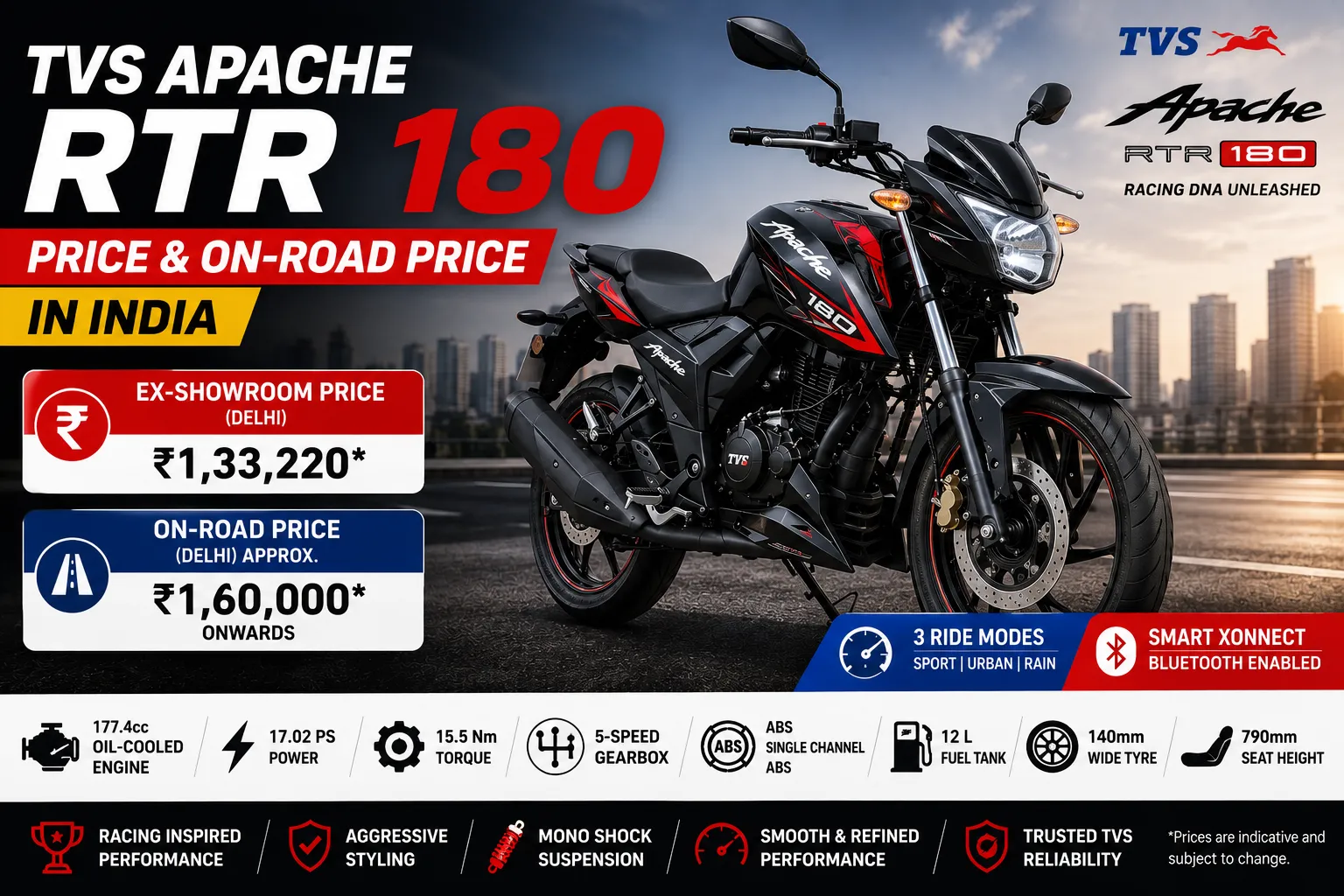
One of the first questions buyers ask is the TVS Apache RTR 180 on-road price. The answer is not exactly the same everywhere in India because the final on-road amount depends on the city, state registration charges, insurance, variant, accessories and other applicable fees. TVS currently lists the Apache RTR 180 from ₹1,33,220 ex-showroom in Delhi, while the manufacturer’s website allows buyers to select their state and city to calculate pricing. Check the official TVS Apache RTR 180 page for the latest location-specific information.
The motorcycle uses a 177.4cc single-cylinder oil-cooled fuel-injected engine. TVS lists maximum output of 17.02 PS at 9,000 rpm and maximum torque of 15.5 Nm at 7,000 rpm in Sport mode. It also gets three riding modes, a five-speed gearbox, monoshock rear suspension, disc braking and a range of technology aimed at making the motorcycle suitable for both everyday riding and enthusiastic weekend use.
In this guide, we look at the TVS Apache RTR 180 price, on-road price, specifications, engine performance, mileage considerations, features, suspension, braking, comfort, maintenance, competitors, buying tips and frequently asked questions.
TVS Apache RTR 180 Price in India
The current TVS Apache RTR 180 price starts at approximately ₹1,33,220 ex-showroom in Delhi, according to TVS’s current Apache range listing. The exact price can vary depending on the selected variant and location.
It is important to understand the difference between ex-showroom and on-road pricing before comparing motorcycles. Ex-showroom pricing generally represents the manufacturer’s listed vehicle price before registration-related costs, insurance and other applicable charges are added.
| Price / Specification | TVS Apache RTR 180 |
|---|---|
| Starting ex-showroom price | ₹1,33,220 onwards in Delhi |
| Engine capacity | 177.4cc |
| Engine type | Single-cylinder, 4-stroke, oil-cooled, fuel injected |
| Maximum power | 17.02 PS @ 9,000 rpm |
| Maximum torque | 15.5 Nm @ 7,000 rpm |
| Gearbox | 5-speed |
| Fuel tank capacity | 12 litres |
| Saddle height | 790 mm |
| Kerb weight | About 140 kg |
TVS’s official technical information confirms the 177.4cc engine, 17.02 PS Sport-mode output, 15.5 Nm torque and five-speed transmission. Exact equipment can depend on the version and market configuration.
TVS Apache RTR 180 On-Road Price
The TVS Apache RTR 180 on-road price is the amount a customer actually needs to pay to register and use the motorcycle on public roads. It is therefore more useful for budgeting than the ex-showroom price alone.
The on-road price normally includes several components:
- Ex-showroom motorcycle price
- Registration and road tax
- Motor insurance
- Standard accessories or mandatory charges, where applicable
- Other dealer or registration-related charges, where legally applicable
Because registration taxes and other charges vary between states, there is no single fixed on-road price for every Indian city.
For example, a buyer in Delhi and a buyer in Kolkata may pay different amounts even when purchasing the same Apache RTR 180 variant. Insurance premiums can also change depending on the policy, insurer and selected coverage.
Why Does the Apache RTR 180 On-Road Price Vary?
Several factors can change the final price displayed by a dealer or online price calculator.
1. State Registration Charges
Registration and road-tax rules are determined according to the applicable state and vehicle-registration requirements. This means a motorcycle’s on-road price can differ substantially between locations.
Before booking, ask the dealer for a complete written quotation showing the individual components instead of accepting only one final number.
2. Insurance
Insurance is another important part of the on-road cost. Different policies can have different premiums and coverage options. Buyers should compare coverage rather than automatically choosing the cheapest quote.
3. Variant
The Apache RTR 180 is offered with different equipment configurations. TVS’s current information lists configurations involving ride modes, SmartXonnect-related technology and different braking or suspension equipment depending on the version.
4. Accessories
Accessories can increase the amount shown on a quotation. Some products may be optional rather than necessary for registration. Always ask the dealer to separate mandatory charges from optional accessories.
TVS Apache RTR 180 Engine and Performance
The heart of the motorcycle is its 177.4cc single-cylinder engine. It uses fuel injection and oil cooling and is paired with a five-speed gearbox.
TVS currently lists maximum power of 17.02 PS at 9,000 rpm and maximum torque of 15.5 Nm at 7,000 rpm in Sport mode. Urban and Rain modes use a lower output setting, with TVS listing 14.54 PS and 14.2 Nm for those modes.
| Engine Specification | Details |
|---|---|
| Displacement | 177.4cc |
| Cylinder configuration | Single-cylinder |
| Cooling | Oil cooled |
| Fuel system | Fuel injection |
| Maximum power | 17.02 PS @ 9,000 rpm |
| Maximum torque | 15.5 Nm @ 7,000 rpm |
| Gearbox | 5-speed |
| Starting system | Electric starter |
This specification gives the Apache RTR 180 a sporty character without making it as physically large as many higher-capacity motorcycles. It can therefore appeal to riders who want an energetic street motorcycle for daily use and occasional longer rides.
Apache RTR 180 Riding Modes
One of the notable features of the motorcycle is its selectable riding modes. TVS provides Sport, Urban and Rain modes.
Sport Mode
Sport mode provides the motorcycle’s highest available engine output. It is intended for situations where the rider wants a more responsive performance character.
This mode can be particularly enjoyable on open roads where there is enough space to ride safely and legally. It should not be treated as an invitation to exceed speed limits or ride beyond the rider’s ability.
Urban Mode
Urban mode provides a calmer engine response and is useful for everyday city riding. In congested traffic, smooth throttle behaviour can be more useful than maximum engine output.
For daily commuting, many riders may find Urban mode more relaxed, particularly when travelling through busy roads, intersections and stop-and-go traffic.
Rain Mode
Rain mode reduces the available engine output and provides a more controlled character. It can be useful when road conditions are wet or when the rider wants a gentler response.
However, a riding mode cannot eliminate the risks associated with wet roads. Tyre condition, road surface, speed and rider behaviour remain extremely important.
Apache RTR 180 Features
The Apache RTR 180 is positioned as a technology-rich sporty motorcycle rather than a basic commuter. Depending on the selected version, TVS highlights features such as SmartXonnect connectivity, ride modes, digital instrumentation and Glide Through Technology.
SmartXonnect
TVS’s SmartXonnect system adds connected functions to the motorcycle. The manufacturer’s information describes features such as Bluetooth connectivity, navigation assistance, call and SMS alerts and riding-related information.
Connected technology can be useful for riders who frequently travel around unfamiliar areas. However, riders should configure their phone and navigation before starting the journey and avoid interacting with a smartphone while moving.
Glide Through Technology
Glide Through Technology, commonly called GTT, is designed to make low-speed movement easier by allowing the motorcycle to start moving with controlled clutch release without requiring throttle input under suitable conditions.
This can be helpful in slow-moving traffic, parking areas and situations where smooth low-speed control is important.
Digital Instrument Cluster
The Apache RTR 180 uses a digital instrument display with information designed around the motorcycle’s sporty character. Depending on the version, the display and connected functions can differ.
Buyers should check the exact equipment list of the variant being offered rather than assuming every Apache RTR 180 has every premium feature.
Apache RTR 180 Suspension and Handling
The motorcycle uses a telescopic front suspension and a rear monotube inverted gas-filled shock absorber with spring adjustment. TVS calls its rear suspension MIG, or Monotube Inverted Gas-filled shock.
The suspension setup is intended to provide a balance between everyday road use and sporty handling. The motorcycle’s relatively compact dimensions also make it easier to manoeuvre through urban traffic than many larger motorcycles.
For riders who frequently travel over broken roads, the best approach is to evaluate the suspension during an actual test ride. A specification sheet cannot tell you exactly how a motorcycle will feel over the roads you use every day.
Apache RTR 180 Brakes and Safety
Braking hardware varies by version, so buyers should confirm the exact configuration before making a purchase. TVS’s current product information lists a front disc brake, rear disc brake and ABS-related equipment depending on the variant.
ABS can help reduce the likelihood of wheel lock under hard braking, but it does not eliminate stopping distance. Riders should still maintain safe following distances and adjust speed for traffic and road conditions.
The official TVS Apache RTR 180 information also highlights its ride modes and safety-oriented electronics as part of the motorcycle’s overall package.
Apache RTR 180 Mileage
Mileage is an important consideration when choosing a motorcycle, especially for riders who use their bike every day.
However, there is no single real-world mileage number that applies to every Apache RTR 180 owner. Fuel consumption depends on traffic, riding style, speed, engine condition, tyre pressure, road gradient, rider weight and how frequently Sport mode is used.
A rider travelling smoothly through open roads may achieve better fuel economy than someone who spends the entire day in congested traffic and frequently accelerates hard.
How to Improve Fuel Efficiency
- Maintain the recommended tyre pressure.
- Accelerate progressively instead of making unnecessary hard launches.
- Use Urban mode when maximum performance is not required.
- Avoid unnecessary high-RPM riding.
- Keep the chain correctly adjusted and lubricated.
- Follow the recommended service schedule.
- Avoid carrying unnecessary weight.
- Maintain a steady speed when traffic conditions allow.
The objective should be efficient and safe riding rather than chasing a particular mileage number at the expense of normal road safety.
Apache RTR 180 Fuel Tank and Practicality
TVS lists a 12-litre fuel tank for the Apache RTR 180. This is a practical capacity for a motorcycle intended to serve both commuters and weekend riders.
Actual range depends on fuel economy. For example, if a rider averaged 40 km/l under a particular set of conditions, a 12-litre tank would mathematically represent 480 km of fuel consumption range. This is only an example, not a guaranteed riding range.
In everyday ownership, riders should avoid relying on the theoretical maximum range because traffic, riding conditions and the usable fuel level can change the result.
Apache RTR 180 Design and Road Presence
The Apache RTR 180 follows TVS’s aggressive RTR design philosophy. The motorcycle features a muscular fuel tank, sharp bodywork, sporty graphics and a compact rear section.
The design is clearly aimed at riders who prefer a performance-oriented motorcycle rather than a conservative commuter. The riding position also reflects the RTR family’s focus on control and sporty handling.
For buyers choosing between motorcycles in this price range, styling is naturally subjective. The best choice is the motorcycle whose ergonomics, seat shape, handlebar position and overall proportions feel comfortable to the rider.
Apache RTR 180 Dimensions and Weight
| Dimension | Approximate Specification |
|---|---|
| Length | 2085 mm |
| Width | 730 mm |
| Height | 1105 mm |
| Wheelbase | 1326 mm |
| Ground clearance | 180 mm |
| Saddle height | 790 mm |
| Kerb weight | About 140 kg |
| Fuel tank | 12 litres |
The approximately 790 mm saddle height should be manageable for many riders, but seat width and rider inseam can make the motorcycle feel different from one person to another. A test ride is therefore recommended before booking.
Apache RTR 180 for City Riding
The Apache RTR 180 can be a practical urban motorcycle because its dimensions are relatively manageable while its engine provides enough performance for normal city travel.
Urban mode can be particularly useful in traffic because it prioritises smoother response rather than maximum output. GTT can also be helpful when moving slowly through congested roads.
The motorcycle’s sporty character may appeal to commuters who do not want a basic commuter design but still need a motorcycle capable of daily use.
Apache RTR 180 for Highway Riding
The 177.4cc engine gives the Apache RTR 180 enough performance for regular highway travel, although buyers should have realistic expectations about a motorcycle in this displacement class.
It can be enjoyable for shorter highway trips and weekend rides, but riders who frequently cover very long distances at high speeds may prefer a larger motorcycle with greater displacement and additional touring equipment.
As with any motorcycle, highway safety depends on maintaining appropriate speed, keeping sufficient following distance and using protective riding equipment.
Apache RTR 180 Comfort
Comfort is often overlooked when buyers focus on power and features. The Apache RTR 180 has sporty ergonomics, but whether it is comfortable for you depends on your height, riding posture and typical journey length.
During a test ride, pay attention to:
- Seat firmness and width
- Handlebar reach
- Footpeg position
- Clutch effort
- Low-speed balance
- Suspension response
- Engine vibration
- Wind exposure at higher speeds
A five-minute dealership ride is useful, but a longer test ride provides a much better idea of how the motorcycle will feel during daily ownership.
TVS Apache RTR 180 vs Apache RTR 160 4V
The Apache RTR 160 4V is one of the closest motorcycles to consider if you are interested in the Apache family. It has a smaller 159.7cc engine but a high-performance four-valve configuration and strong feature package.
| Factor | Apache RTR 180 | Apache RTR 160 4V |
|---|---|---|
| Engine | 177.4cc | 159.7cc |
| Engine character | Sporty | More performance-focused |
| Maximum power | 17.02 PS | 17.55 PS in Sport mode |
| Gearbox | 5-speed | 5-speed |
| Ride modes | Yes | Yes |
| Best suited to | Sporty daily riding | Performance-focused 160cc buyers |
If your budget is close to the two models, compare the exact variant prices and equipment rather than deciding solely on engine displacement. The TVS Apache RTR 160 4V price and on-road price guide can help when comparing the two Apache models.
Apache RTR 180 vs Other 180cc and 200cc Bikes
The Apache RTR 180 competes for attention with motorcycles around the 160cc-to-200cc range. Buyers may also compare it with the Apache RTR 200 4V, Bajaj Pulsar models, Hero’s performance motorcycles and other sporty commuter motorcycles.
The important comparison points should include more than horsepower. Look at:
- On-road purchase price
- Engine performance
- Fuel economy
- ABS configuration
- Suspension quality
- Tyre size
- Seat comfort
- Service network
- Spare-parts cost
- Insurance cost
- Resale expectations
A motorcycle that appears cheaper at the time of purchase may not necessarily be cheaper over several years of ownership.
Apache RTR 180 Maintenance
Routine maintenance is essential for keeping the motorcycle reliable and performing properly.
Owners should follow the service schedule provided by TVS and use recommended lubricants and replacement parts. Chain condition, tyre pressure, brake-pad wear, engine oil and air-filter condition should receive regular attention.
It is also sensible to keep copies of service invoices and records. A complete maintenance history can be useful when diagnosing problems and may also help when selling the motorcycle later.
Basic Ownership Checklist
- Check engine oil according to the recommended procedure.
- Maintain correct tyre pressure.
- Inspect brake pads and discs.
- Keep the drive chain clean, lubricated and correctly adjusted.
- Check lights and indicators regularly.
- Follow scheduled servicing.
- Inspect tyres for damage or excessive wear.
- Do not ignore warning lights or unusual engine noises.
How to Calculate the TVS Apache RTR 180 On-Road Price
If you are planning to purchase the motorcycle, use the following process to calculate your actual budget.
- Select the exact variant. Do not calculate using only the model name.
- Confirm the latest ex-showroom price. Prices can change over time.
- Ask for the RTO and road-tax amount. These depend on the registration location.
- Compare insurance. Check coverage as well as premium.
- Separate optional accessories. Do not confuse accessories with mandatory charges.
- Check finance costs. Include processing fees and other loan-related expenses when applicable.
- Request a written quotation. This makes the final amount easier to verify.
- Confirm model year and vehicle details. This is particularly important when dealers have multiple production batches.
For official government information relating to licensing and transport services, buyers can also consult the Government of India’s Parivahan Sewa portal.
Tips Before Buying the Apache RTR 180
Take a Proper Test Ride
Do not make the decision based only on specifications. Try the motorcycle in slow traffic, open roads and different riding modes where possible.
Compare the Exact On-Road Quote
Two dealers can sometimes present different totals because of insurance selection, accessories or other charges. Ask for an itemised quotation.
Consider Your Daily Usage
If most of your riding is in heavy traffic, the Apache’s Urban mode and GTT can be useful. If weekend performance is more important, Sport mode and the motorcycle’s handling characteristics become more relevant.
Check Service Availability
A good authorised service centre near your home or workplace can make long-term ownership considerably easier.
Do Not Ignore Safety Equipment
Budget for a properly fitting helmet and appropriate protective riding gear rather than spending the entire purchase budget on the motorcycle itself.
You can also explore more motorcycle buying information and price guides on BikeDekho360’s homepage.
Common Mistakes to Avoid
1. Confusing Ex-Showroom Price With On-Road Price
The starting ex-showroom figure is not the amount you necessarily pay after registration, insurance and other applicable costs.
2. Comparing Different Variants
Always compare the same equipment level. A motorcycle with premium suspension, electronics or braking equipment may have a significantly different price.
3. Assuming Mileage Will Always Be the Same
Fuel economy depends heavily on riding conditions. Avoid treating any claimed or advertised mileage figure as a guaranteed real-world result.
4. Buying Only for Maximum Power
Power is only one part of a motorcycle. Comfort, braking, tyres, suspension, service availability and running costs matter just as much.
5. Skipping the Test Ride
A specification sheet cannot tell you whether the seat, handlebar position and suspension feel comfortable for your body and roads.
6. Adding Too Many Accessories
Accessories can quickly increase the final bill. Decide which products are genuinely useful before accepting a package from the dealer.
Pros and Cons of the TVS Apache RTR 180
| Pros | Cons |
|---|---|
| Sporty 177.4cc engine | Not designed primarily as a relaxed commuter |
| 17.02 PS maximum power | Higher running costs than smaller commuter bikes can be expected |
| Three riding modes | Exact equipment varies by variant |
| SmartXonnect-related technology | Premium features can increase the purchase price |
| Monoshock rear suspension | Wind protection is limited for highway touring |
| Strong sporty styling | Buyers seeking maximum mileage may prefer a smaller commuter |
Frequently Asked Questions
What is the TVS Apache RTR 180 price in India?
The current TVS listing shows the Apache RTR 180 from approximately ₹1,33,220 ex-showroom in Delhi. The exact price can vary by variant and location.
What is the TVS Apache RTR 180 on-road price?
The on-road price depends on the city, registration charges, insurance, variant and other applicable costs. Therefore, buyers should obtain a location-specific quotation rather than relying on one nationwide figure.
What is the engine capacity of the Apache RTR 180?
The motorcycle uses a 177.4cc single-cylinder engine with fuel injection and oil cooling.
How much power does the Apache RTR 180 produce?
TVS lists a maximum output of 17.02 PS at 9,000 rpm in Sport mode and maximum torque of 15.5 Nm at 7,000 rpm.
Does the Apache RTR 180 have riding modes?
Yes. TVS lists Sport, Urban and Rain riding modes for the current Apache RTR 180.
Does the Apache RTR 180 have a 5-speed gearbox?
Yes. The Apache RTR 180 uses a 5-speed gearbox.
What is the Apache RTR 180 fuel tank capacity?
TVS lists a 12-litre fuel tank for the motorcycle.
Is the Apache RTR 180 good for daily use?
It can be a good choice for riders who want a sporty motorcycle that can also handle daily commuting. Its riding modes and GTT technology can be useful in city traffic, while the 177.4cc engine provides more performance than a typical commuter motorcycle.
Should I buy the Apache RTR 180 or a 160cc bike?
The answer depends on your priorities. If you want more displacement and a sporty character, the RTR 180 is worth considering. If purchase price, efficiency and a lighter performance-oriented package are more important, a 160cc motorcycle such as the Apache RTR 160 4V may be a better fit. Compare the exact variants and on-road prices before deciding.
Who Should Buy the TVS Apache RTR 180?
The Apache RTR 180 makes the most sense for riders who want a motorcycle that sits between a conventional commuter and a larger performance motorcycle.
It is particularly suitable for buyers who:
- Want sporty styling and performance.
- Need a motorcycle for everyday city riding.
- Enjoy weekend rides.
- Want selectable riding modes.
- Prefer a 177cc-class motorcycle over a basic 100cc or 125cc commuter.
- Want connected features on applicable variants.
- Prefer the Apache family’s racing-inspired design.
It may be less suitable for someone whose only priority is maximum fuel efficiency or extremely soft commuter-oriented suspension.
Who Should Consider Another Motorcycle?
If your typical usage consists almost entirely of short urban trips and fuel economy is the highest priority, a 100cc or 125cc commuter may make more financial sense.
If you regularly carry a passenger on long highway journeys, a larger motorcycle may provide a more relaxed experience.
Likewise, riders who want a high-end electronics package or substantially greater highway performance may want to consider motorcycles above the 200cc segment.
Final Verdict: Is the TVS Apache RTR 180 Worth Buying?
The TVS Apache RTR 180 remains an appealing option for riders who want a sporty motorcycle without moving into a much larger engine category. Its 177.4cc oil-cooled fuel-injected engine produces 17.02 PS and 15.5 Nm in Sport mode, while the five-speed gearbox and three riding modes give it a flexible character for different riding situations.
✅ Recommended Reviews:
The current TVS range lists the motorcycle from ₹1,33,220 ex-showroom in Delhi. However, anyone searching for the TVS Apache RTR 180 on-road price should remember that the final amount depends on the registration location, insurance, variant and applicable charges.
The motorcycle’s strongest points are its sporty engine character, aggressive styling, ride modes, connected technology on applicable variants and practical dimensions. It can work as a daily motorcycle while still providing an engaging experience when the road opens up.
Before making a final decision, take a proper test ride, compare the exact variant with competing motorcycles, ask for an itemised on-road quotation and calculate expected fuel, insurance, servicing and tyre costs. This will give you a much clearer picture of the motorcycle’s actual ownership value than the ex-showroom price alone.
For the latest manufacturer information, specifications and location-specific pricing, use TVS’s official Apache RTR 180 information. For government transport and licensing information, refer to Parivahan Sewa.
Last Updated: September 2026